A decision platform for solo founders using AI.
You speak or type. AI structures it.
You authorize or park. It's locked — traceable, verified, yours.
From spoken intent to traceable proof. One decision, fully governed.
AI agents are executing at scale. Writing code, booking suppliers, sending communications. But their decisions are untraceable, unverified, and legally exposed. The moment you can't prove who decided what, and when, you've lost more than context. You've lost control.
Three forces converged.
The window is 18 to 24 months.
Every day without traceability is a day your business forgets itself.
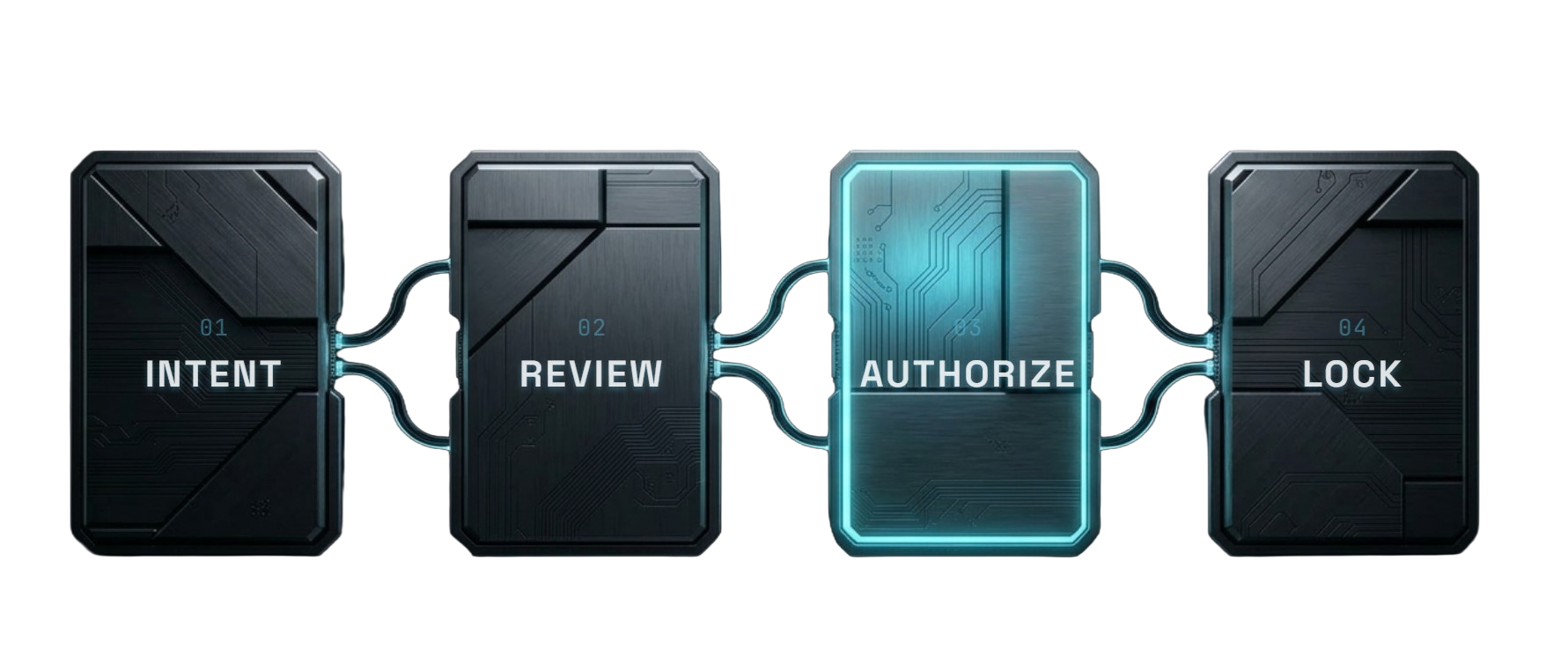
Every decision, observation, idea, or action starts as intent.
You speak it. The system catches it. From there, it's reviewed, authorized, and locked — permanently.
You speak or type. AI structures it into fields with a confidence score. High confidence goes to review. Low confidence goes to your inbox. You authorize with one tap — or park it for later. The boundaries are defined once: as fixed decision rules, not a settings menu.
I'm a pattern maker and couture sewist. Every product requires hundreds of decisions — materials, prices, construction choices, timing. Miss one, and the next product starts from scratch.
When I brought AI into my process, I didn't find a tool that could hold that context. So I built one — using Notion and n8n to validate the protocol in 3 weeks. Voice and text input, AI-powered parsing, confidence-based routing, human authorization, and a locked decision log. The decision logic is designed to extract into a dedicated infrastructure layer. Then I used that system to build itself: every architectural decision, every version change, every governance document was captured, authorized, and traced through ATZCore.
But while building it, I realized: this isn't a fashion problem. Every solo founder running AI is making the same untraced decisions, buying disconnected workflows, losing the thread back to their core vision.
That's when ATZCore stopped being mine — and became the product.
ATZCore is not a prototype. It is an active system that registered its own architectural gaps, documented its own version decisions, and held under real operational pressure. Every moment of truth is captured, reviewed, and locked.
Every decision has a recorded authorization.
Every session has a structured report.
Every document has a Trace ID.
During the 3-week build, ATZCore governed its own development. On day 11, it detected a structural weakness: the AI layer was handling two jobs — mechanical enforcement and intelligent verification. Four process failures in two days proved that mechanical work is where AI structurally fails.
The response wasn't to add more rules. It was to restructure: separate ATZCore from its first implementation, split governance into 5 dedicated files, and design the mechanical layer as standalone automation.
Then the system proved itself. Version 1.7 of the core instruction file was overwritten without archival. The system detected it, documented the cause, and generated a new rule: "archive before you edit." It has never happened again.
The system surfaced this in real time — while it was half-built.
You open ATZCore. You speak or type what you just decided, observed, or planned. The system structures it, scores its confidence, and presents it back to you. One tap: authorize or park. Done. Your decision is locked with a Trace ID, a timestamp, and your explicit authorization. It takes seconds — faster than writing a note, more structured than any chat thread.
Three layers make this work. The mechanical layer handles routing, validation, and writes. The intelligent layer — AI, model-agnostic — parses your input into structured fields. The strategic layer is you: every final decision requires your explicit authorization.
The current system runs on Notion and n8n. The architecture is modular: database, parser, and orchestration are separated by design. The next step is a standalone hosted platform where every user gets their own environment — their own decision log, their own trace history, their own rules.
AI and automation only work when the data underneath is structured from the start. Not cleaned up later. Not reconstructed from memory. Captured at the moment of truth, and locked in place.
That Trace ID is what makes every pattern visible, every boundary sharper, and every next decision faster. The system learns the core of your business — in your words, at your pace, on your terms.
Interfaces can be rebuilt. Decision history can't be faked. It holds the verified record of how you run your business — and that record is irreplaceable. Not because of the software. Because it's yours.
That history becomes the foundation your AI agents operate from. They don't guess. They don't hallucinate your business logic. They work within boundaries you defined and authorized yourself.
This is not Notion AI. Notion helps you write documents. ATZCore captures decisions — immutable after authorization, semantically structured, and traceable across your entire operation. Documents are static. Decisions are structural. The longer you use it, the denser your decision graph — and the higher the switching cost.
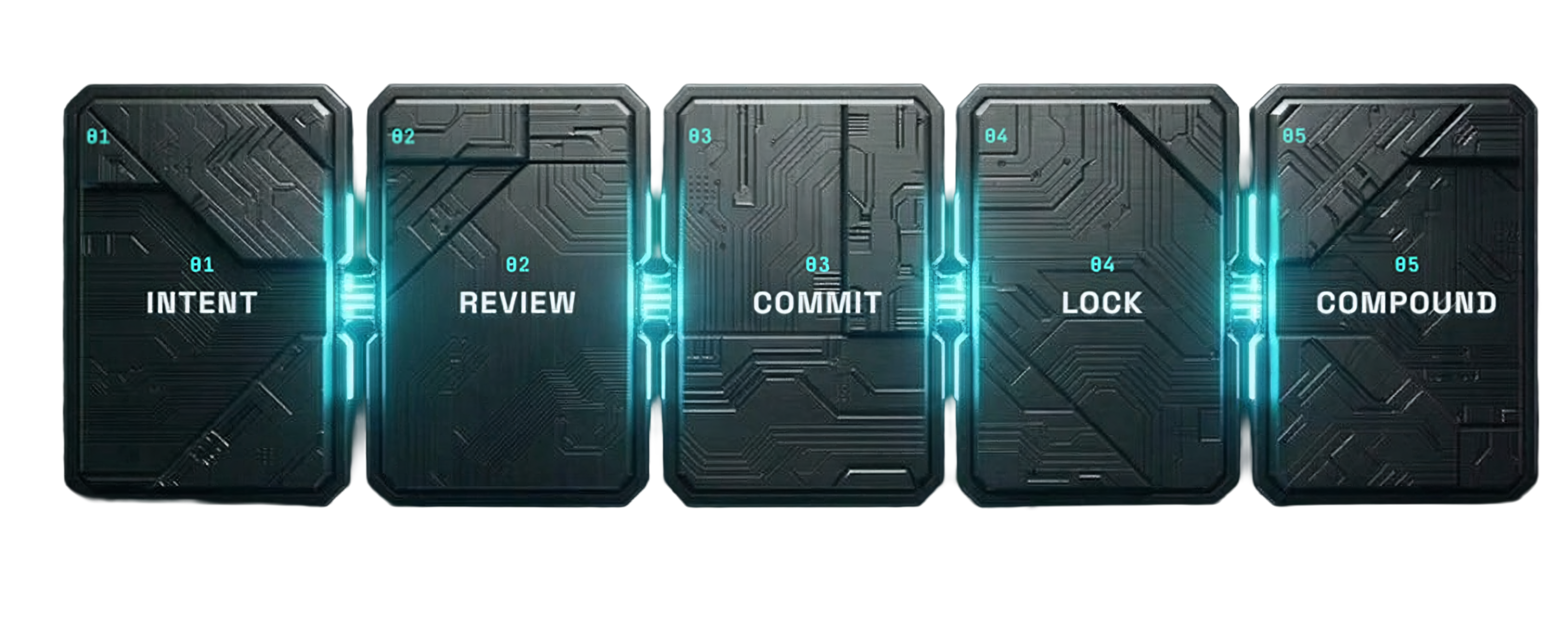
Every decision you lock adds to the system. After enough locks, something shifts — the system stops just recording. It starts recognizing. Patterns. Boundaries. The logic of how you operate. That is compound. And compound is what turns a tool into infrastructure. Once the system understands how you operate, it can do more than record.
It won't just remember your business. It will help manage it within your rules.
And what comes next changes everything.
Today, most of what a business knows lives in people's heads. Meetings exist to transfer context. Onboarding takes months. When someone leaves, their knowledge walks out the door.
ATZCore changes that. Every decision, every boundary, every pattern is already in the system — structured, traceable, and permanent. New team members don't start from zero. They start from proof.
Everything runs faster. Automation becomes safer — because the data underneath is verified. Workflows become accurate — because they build on real decisions, not assumptions.
Every user gets their own environment. Their own decision log. Their own trace history. Their own rules. The more decisions you lock, the more the system understands how you operate — and the stronger the foundation for automation, delegation, and scale.
Less time in meetings. More time managing the system that runs your business.
AI and automation are reshaping how businesses operate. That's not a prediction. It's already happening. The divide isn't between those who use AI and those who don't. It's between those who govern it and those who hope for the best.
ATZCore is for the ones who choose to lead.
Not by fighting the current, but by building the system that channels it.
You open one app.
You see what AI has proposed.
You authorize what matters.
Everything else runs within boundaries you defined once.
ATZCore is not another tool in your stack. It is the layer where every decision is captured, confirmed, and made traceable. The longer you use it, the more valuable your decision history becomes.
30.4 million solo operators in the U.S. alone — founders running real businesses, managing suppliers, clients, and AI agents, without a team to catch what falls through. AI is accelerating what one person can do, but no tool governs or traces the decisions behind the work.
I'm not starting from zero. I'm starting from proof.
I'm a domain expert who built the product with AI as my engineering layer. That's not a limitation — that's the thesis. If one person with AI tools can build a working decision system in 3 weeks, that's exactly the point ATZCore proves.
The protocol is validated. The architecture is modular. The proof is recursive — the system documented its own creation. What I need now is the bridge from demo to deployment.